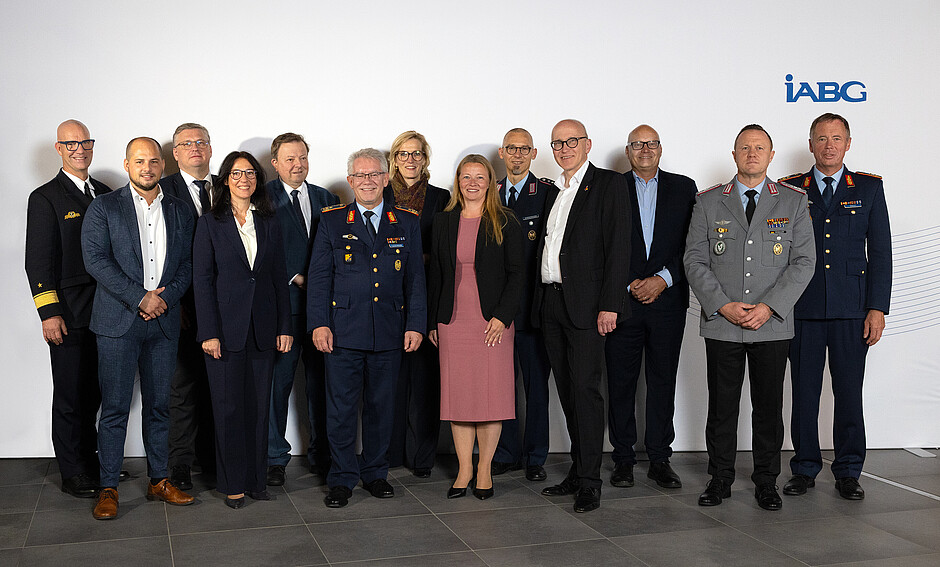
Ottobrunn, 21 October 2026 – Germany and Europe are rapidly expanding their space capabilities. By learning from the experience of other spacefaring nations, they have an opportunity to integrate new civil and military capabilities into a robust overall architecture from the outset. This was one of the key messages of the 3rd Space Symposium organised by IABG and the German Air Force Association (Interessengemeinschaft Deutsche Luftwaffe e.V., IDLw). Around 200 representatives from politics, the Bundeswehr, industry and academia gathered in Ottobrunn on 21 October to discuss these challenges. The symposium was held under the theme “Resilient Overall Architecture in Space – Civil, Military, Integrated”.
In his keynote address, Florian Hahn, Minister of State at the Federal Foreign Office, described space security as a responsibility for Germany as a whole and for Europe. Referring to the German government's Space Security Strategy, he emphasised that Germany must remain capable of acting in space – in peacetime, during crises and in the event of armed conflict. According to Hahn, the German government plans to invest around €35 billion in military space security and its own space security architecture by 2030. For Hahn, resilience is above all a matter of preparation: “Resilience does not mean that nothing ever fails. Resilience means that a failure does not immediately result in the loss of our ability to act. […] Resilience does not emerge at the moment of crisis. It is built through decisions we make beforehand.”
As investment increases, so does the pressure to deliver. The focus of the symposium series has also evolved since 2024: from raising awareness of space as a security domain, through the legal framework, to practical implementation. Speed and a common architecture must be considered together, as integrating systems at a later stage often involves considerable effort.
Prof. Dr Rudolf F. Schwarz, Chairman of the IABG Executive Board, said in his opening address: “Europe's ability to act increasingly depends on how reliably our space capabilities work together. We must integrate civil and military systems, as well as the capabilities of our European partners, into a robust overall architecture. What matters is ensuring that the services we need remain available even in times of crisis.”
When Satellite Services Fail, Everyone Is Affected
Disruptions to satellite navigation in aviation caused by jamming and spoofing already demonstrate how heavily everyday life and security depend on space-based services. If navigation or communication services fail, logistics, agriculture and essential supplies are also affected. “Space is part of our critical infrastructure, and maintaining our full operational capability in space is of strategic importance. Space security is not a niche issue; it requires a whole-of-government approach,” said retired Lieutenant General Klaus Habersetzer, President of IDLw.
For the armed forces, this connection is particularly direct. Larger, interconnected satellite constellations can provide a more up-to-date situational picture and shorten response times. At the same time, protective and countermeasures are becoming necessary to safeguard their own forces. A resilient architecture therefore means more than simply ensuring that satellites remain available. This also applies to rapidly deployable space capabilities, known as Responsive Space: launch systems alone are not enough; satellites and payloads must also be ready for deployment at short notice.
Civil and commercial services can also complement military capabilities. To ensure their reliable integration in a crisis, questions of availability, protection, access rights and service prioritisation must be resolved in advance. Such an architecture must coordinate national contributions with the capabilities of European partners.
Dr Nicolaus Hanowski, Head of Mission Management & Ground Segments at the European Space Agency (ESA), highlighted the scale of the integration challenge at European level. Europe has highly capable Earth observation systems, but national, European and commercial capabilities are not yet sufficiently interconnected. Ground stations and data networks also remain vulnerable. Initiatives such as European Resilience from Space (ERS) and the Earth Observation Governmental Service (EOGS) aim, among other things, to close observation gaps and improve the integration of Earth observation, secure communications and navigation.
Putting the Strategy to the Test
The first panel examined how the strategy is being translated into practice. Panellists included Lieutenant General Holger Neumann, Chief of the German Air Force; Major General Armin Fleischmann, Deputy Chief of the Cyber and Information Domain Service; and Major General Wolfgang Ohl, Deputy Director-General of the Armed Forces Directorate at the Federal Ministry of Defence.
The interim assessment after one year was positive: according to Ohl, around a quarter of the strategy's 65 measures have either been completed or moved into continuous implementation, almost 70 per cent have been initiated, and only four remain outstanding. Plans are increasingly being translated into operational capabilities. For the first time, the Bundeswehr is training its own personnel to operate satellites, distributing ground stations across multiple locations to prevent a single failure from disabling the entire system, and securing launch capacity through reservation contracts.
Space Conflicts: Where International Law Sets Limits
In the second panel, representatives from the Bundeswehr, academia and industry explored an IABG scenario in which a fictitious adversary escalates a conflict through several stages, from crisis to war. Panellists included Major General Michael Traut, Commander of the Bundeswehr Space Command; Dr Philipp Klüfers of IABG, who developed the scenario; and Prof. Dr Dr h.c. Dr h.c. Stephan Hobe, Director Emeritus of the Institute of Air Law, Space Law and Cyber Law at the University of Cologne.
It quickly became clear that reality had already caught up with parts of the scenario: some developments originally envisaged for later stages of escalation are already occurring today.
A fundamental question was which deterrence concepts could prevent potential adversaries from attacking space infrastructure. Given the numerous hybrid threats below the threshold of an armed attack, the panellists argued that political and military decision-makers need to define their own “red lines”. The discussion also highlighted that space systems may become targets of hostile interference even before a conflict breaks out – for example, through the disruption of reconnaissance systems on which political and military decision-makers depend.
How far a state may go in such situations is also a question of international law. For Hobe, the legal framework is clear, but its application is difficult: “International law places clear limits on military self-defence – including in space. A merely suspected threat does not justify a military counterstrike. The situation becomes particularly difficult when an attack cannot be clearly attributed. Anyone exercising the right of self-defence must, at the very least, make every effort to ensure that their measures are directed against the actual attacker.”
Alongside attribution, responsibilities, decision-making authority and rules of engagement must also be clarified. These are essential prerequisites for enabling political leaders to make swift and legally sound decisions in a crisis.
From Concept to Operational Capability
At the end of the day, representatives from BDLI, Airbus, OHB, Rheinmetall and the Bundeswehr discussed how technology can be translated into operational capability.
The industry is gaining momentum: the space segment of BDLI member companies grew by 17 per cent between 2024 and 2025, and many companies are already making substantial upfront investments in personnel and production capacity.
The SPOCK 1 project demonstrated just how quickly progress can be made: only four months elapsed between the invitation to tender and the signing of the contract, with the first data delivered the very next day.
Following this rapid expansion, industry now needs reliable long-term planning prospects. To support this, the Bundeswehr intends to extend its dialogue with companies to the technical and operational levels.
The panellists agreed that the challenges can only be overcome through joint efforts, including the involvement of SMEs and start-ups. Courage, confidence and mutual trust were seen as essential to success.