
What the AI Act is really about
Understanding requirements for AI systems and implementing them in a structured manner
The AI Act creates a uniform legal framework for the use of artificial intelligence across Europe for the first time. It focuses on the question of the conditions under which AI systems can be used in a safe, traceable and trustworthy manner.
Unlike traditional product regulation, the AI Act not only assesses the system itself, but also its context of use. The requirements are based on the risk posed by an AI system.
For companies, this means that the use of AI becomes a regulated task requiring verification - from development to operation.
What you should know about the AI Act - FAQ
Which AI systems are affected?
Which AI systems fall under the AI Act
The AI Act applies to systems that are based on AI - especially if they support or automate decision-making. The decisive factor is not only the technology, but also its planned and foreseeable intended use.
The following are affected, for example
- AI-based control and assistance systems
- Image processing and object recognition
- Prediction and optimization algorithms
- Autonomous or semi-autonomous functions
Not affected by the AI Act
AI systems in the areas of national security, defense and military purposes are excluded from the AI Act. In addition, the Act does not apply to pure research, testing or development activities as long as systems or models have not yet been placed on the market or put into operation.
Roles and responsibilities
Similar to the CRA, the AI Act distinguishes between different players along the value chain:
- Manufacturers (development and provision of AI systems)
- Importers (introduction to the EU market)
- Operators (use of the AI system)
- Authorized representatives (representation of the manufacturer within the EU)
Depending on the role, different obligations arise - especially between manufacturers and operators.
Risk classification as a key difference
Requirements depend on the risk of the AI system
The AI Act distinguishes between different risk categories - from minimal risk to high-risk AI.
- Low risk: low requirements
- High-risk AI: comprehensive regulatory obligations
High-risk systems in safety-critical applications are particularly relevant when the AI performs a safety function or when its failure could endanger health and safety.
General purpose AI (GPAI) - AI models that can be used for a wide range of applications - are also taken into account. Depending on the application and performance, extensive requirements may also apply here
What does the AI Act specifically require in relation to high-risk AI?
Requirements along the AI life cycle
The requirements of the AI Act relate to both the development and operation of AI systems.
Development and design
Key requirements must already be met during development:
- Risk management system
- Data quality and data management
- Technical documentation
- Ensuring accuracy, robustness and cyber security
AI systems must be designed to be comprehensible and controllable.
Transparency and control
A key difference to other sets of rules is the requirement for dealing with decisions:
- Transparency about functionality and use
- Traceability of results
- Possibilities for human supervision
This ensures that AI systems do not remain "black boxes".
Conformity and placing on the market
The following evidence is required for regulated AI systems:
- Conformity assessment
- CE marking
- Declaration of conformity
- Registration in relevant databases
Operation and monitoring
There are also extensive obligations during operation:
- Monitoring of system behavior
- Documentation of events
- Reporting of serious incidents
- Ongoing evaluation of system performance
Why implementation is complex
The challenge lies not only in the technology, but also in the combination of technology, regulation and application context.
Practice shows that
- Requirements depend heavily on the specific application
- AI systems change through data and updates
- Interfaces with the Machinery Ordinance and Cyber Resilience Act
- High documentation and traceability requirements
The combination of AI development, system integration and regulatory assessment is particularly challenging. The EU's Digital Omnibus therefore provides for additional mechanisms to reduce duplicate requirements, redundant checks, and parallel documentation and reporting obligations across different regulatory frameworks.
When does the AI Act come into force?
The AI Act will come into full force on August 2, 2027. However, parts of it will apply earlier.
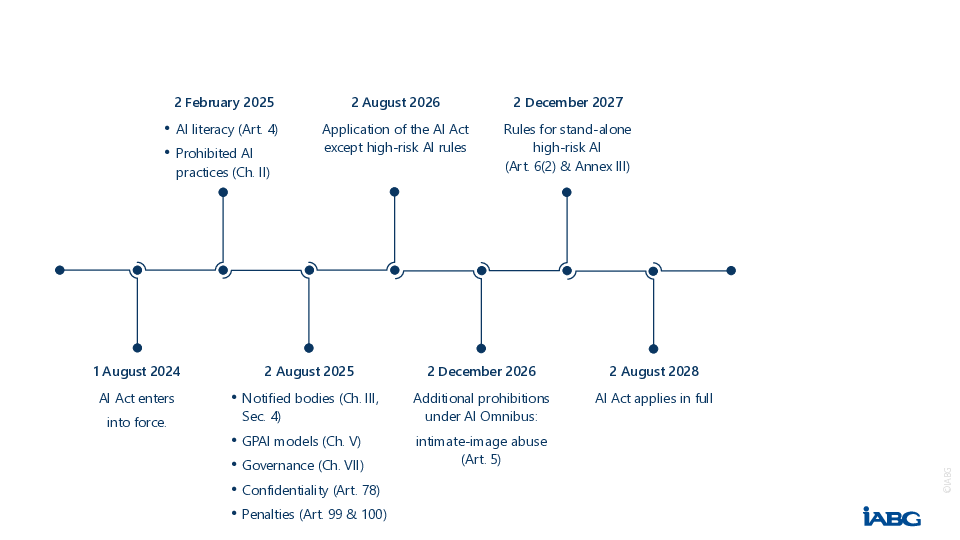
Please note: The regulatory framework for AI is evolving rapidly. Through the proposed “Digital Omnibus”, the EU aims to make regulatory requirements more practical while strengthening European competitiveness. This includes discussions around adjustments to timelines and requirements for high-risk AI systems.
What happens in the event of violations?
Infringement Penalty Use of prohibited AI systems Up to €35 million or 7% of the total global annual turnover of the previous financial year, whichever is higher Non-compliance with obligations (excluding use of prohibited AI systems) Up to €15 million or 3% of the total worldwide annual turnover of the previous financial year, whichever is higher False/misleading/incomplete information provided to notifying bodies or market surveillance authorities Up to € 7.5 million or 1% of the total worldwide annual turnover of the previous financial year, whichever is higher Non-compliance obligations by providers of AI models for general purposes Up to €15 million or 3% of the total worldwide annual turnover of the previous financial year, whichever is higher Note: For newly established companies and SMEs, the lower amount applies instead of the higher amount.
Typical questions from practice
Companies are often faced with the following questions:
- Is my system an AI system as defined by the AI Act?
- Which risk category does my application fall into?
- What specific requirements apply to my system?
- How do I ensure traceability and transparency?
- What impact do updates or new data have?
- How do I integrate AI requirements into existing processes?
Structured implementation with experts from IABG
The requirements of the AI Act not only affect individual components, but also the entire system and its use.
IABG provides support with:
- Classification of AI systems and risk classes
- Integration into existing development and safeguarding processes
- Validation and evaluation of AI systems
- Development of verification and documentation structures
Please find more information on
I am looking forward to your message.

How can we help you?
Please fill in the form and we will get in touch with you as soon as possible.
This section contains third-party content that you can view with a single click.
By loading the form, personal data may be transmitted to the third-party provider. You can find more information in our privacy policy