Research Project

Anticipate risks.
Plan maintenance more effectively.

Research Project

Anticipate risks.
Plan maintenance more effectively.

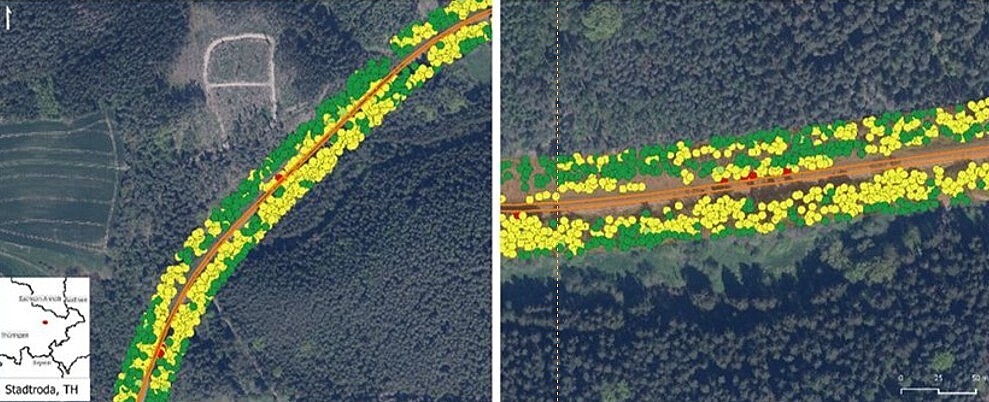
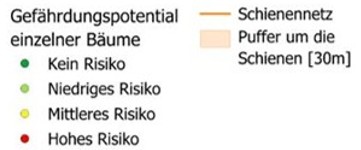
"Green Along the Tracks" Findings: Potential Hazards Posed by Individual Trees

Vegetation Management

Vegetation along railroad tracks must be regularly inspected and maintained to identify risks to railroad operations at an early stage. DB Guideline 882 defines, among other things, requirements for clearing and stabilisation zones. However, on-site inspections by qualified personnel are time-consuming and costly.

The demonstrator we developed maps out the entire process – from inventory and condition assessment through growth forecasting to the needs-based planning of inspections and measures. Multispectral and LiDAR data from trains, drones, or aircraft, as well as satellite data, can be used for this purpose. AI-supported methods analyse the data and make it possible to identify individual trees, detect deadwood, and determine height and distance from the track.

In conjunction with growth models, it is possible to estimate when a critical condition might be reached. This allows inspection intervals and maintenance measures to be better aligned with the actual risk and reduces unnecessary on-site inspections.

In addition, a study was conducted to determine how sight lines that must be kept clear at technically unsecured railroad crossings can be automatically identified and assessed for critical vegetation.

User Interface of the Demonstrator (Web Application)

Lifetime Wear and Tear on Vehicle Structures

Structural fatigue develops over a long period of time and is initially neither visible nor immediately recognisable as a loss of function. For maintenance tailored to actual needs, it is therefore crucial to know how heavily a vehicle structure has actually been stressed and how further operations will affect its remaining service life.

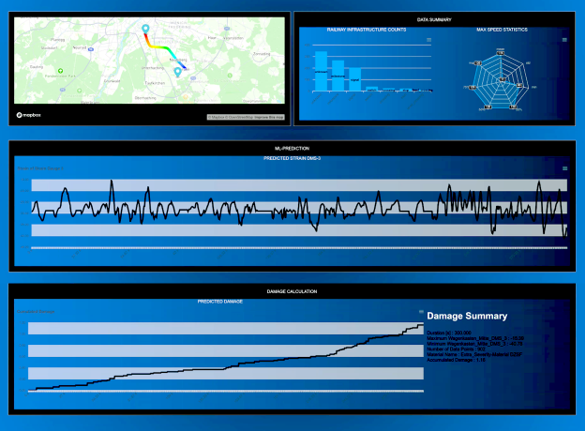
The vehicle demonstrator links track characteristics – such as speed, track alignment, switches, and stops – to the resulting local structural stresses. A trained machine-learning model predicts these stresses for a selected route; a structural integrity model then derives the accumulated damage from these predictions.

This allows routes already traveled to be evaluated in terms of their service life consumption to date and enables the estimation of additional stresses for planned routes. Maintenance could thus be better aligned with a vehicle’s actual usage profile. Further validation is required for application to real-world fleets.

From Research to Practical Application

The demonstrators developed are proofs of concept and not products ready for immediate use. However, they demonstrate how data, physical models, and machine learning methods can be integrated into end-to-end diagnostic and predictive chains.

For specific applications, these approaches can be adapted to the respective infrastructure, vehicles, available data, and operational processes. In the future, such analysis chains could also serve as building blocks for a digital twin.

Customer Testimonial

Project: “Diagnosis and Prognosis for Maintenance Management in Rail Transport”

The project was characterised by highly competent, reliable and open collaboration throughout. Particularly noteworthy was the willingness to consider alternative proposals and different solution approaches, and to work together in finding pragmatic compromises. The project outcomes were documented to a high standard, coordination was transparent and goal-oriented, and the reliable way of working enabled efficient project delivery with minimal management oversight.

Overall, the project was delivered in a highly professional, efficient and collaborative manner, making it a genuine pleasure to work together.

Axel SimrothGerman Centre for Rail Traffic Research at the Eisenbahn-Bundesamt (DZSF)
Contact