- Home
- Services
- Testing & Qualification
- Product Qualification
- High Risk Testing
- Abuse and Safety Tests on Batteries
- Home
- Services
- Testing & Qualification
- Product Qualification
- High Risk Testing
- Abuse and Safety Tests on Batteries

High-Voltage (HV) and Low-Voltage (LV) Battery Energy Storage Systems
Safety and Abuse Testing for Battery Systems
Errors in handling, defects or accident scenarios can cause HV and LV battery energy storage systems to enter critical states. Particularly in the case of high energy capacities and large-scale system dimensions, targeted safety and abuse testing is required in order to understand and assess behaviour under extreme conditions. At our DIN 17025-accredited competence centre for Abuse Testing and Safety Testing in Lichtenau, we carry out such tests on battery systems – including beyond the usual load limits and standard requirements.
Our Approach to Battery Safety Testing
What is abuse testing?
Abuse tests are testing procedures in which battery systems are deliberately exposed to conditions beyond their intended operating limits. These include, for example, mechanical damage, thermal overload and electrical fault conditions.
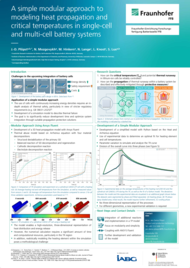
In the context of lithium-ion batteries, the aim is to assess how the system responds under such extreme conditions and whether critical events such as thermal runaway, fire or structural failure occur. In addition to triggering these effects, particular attention is paid to how they propagate within the system, for example through thermal propagation.
Unlike standards-based testing, which verifies compliance with defined minimum requirements, abuse testing is intended to provide a deeper understanding of system behaviour under realistic fault scenarios and to assess potential risks beyond regulatory requirements.
How are batteries tested?
The aim is to understand and analyse the behaviour of battery systems under misuse, defects or external influences, with a particular focus on safety-critical reactions. In the context of battery systems, abuse testing typically includes:
- mechanical damage, for example through crush, impact or drop tests
- thermal overload, such as external fire exposure or overheating
- electrical fault conditions, including overcharging or short circuits
- intrusive procedures, such as the deliberate damage of individual cells (e.g. nail penetration)
The tests analyse whether critical events such as thermal runaway, fire or explosion occur, and how these effects propagate within the battery system.
Unlike standards-based testing, which verifies compliance with defined minimum requirements, abuse testing is intended to provide a deeper understanding of system behaviour under realistic extreme conditions and to assess potential risks beyond regulatory requirements.
What role do standards play?
Who needs battery safety and abuse testing?
Safety and abuse testing is relevant for all companies involved in the development, integration or operation of battery systems. This includes, in particular, vehicle and battery system manufacturers, automotive suppliers, as well as companies operating in sectors such as aerospace, commercial vehicles and industrial applications.
Such testing is becoming increasingly important, especially in application areas where fully established standards do not yet exist or where specific operating conditions must be taken into account. In these cases, abuse testing helps to identify safety-critical risks at an early stage, validate system behaviour and provide a reliable basis for design decisions and approval processes.
Testing from cell level to complete vehicle
We test battery systems with high energy capacities and large physical dimensions. This enables investigations under conditions that go beyond typical standard testing and place special demands on infrastructure and safety.
Specific testing for battery systems
We support you throughout the entire development process with both type-approval-related and development-accompanying testing. This includes standardised testing in accordance with ECE R100, KMVSS and relevant GB standards, as well as customised safety and abuse testing. Our portfolio includes:
- Mechanical abuse and intrusion testing, e.g. crush, drop and impact tests, nail penetration tests
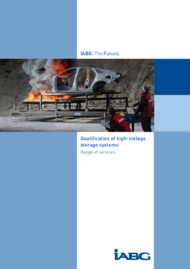
- Thermal propagation and fire testing
- Electrical testing, e.g. overloading and electrical overstress
Risk assessments (including ISO 26262)
Customised test concepts and test environments
In addition to standardised testing, we develop and implement customised test setups and dedicated test rigs tailored to specific projects and test objects in order to realistically reproduce application-specific scenarios. This also includes investigations on battery systems for commercial vehicles as well as testing at complete vehicle level.
We particularly address applications in which the use of electrical energy storage systems is still only partially standardised. Our customers benefit from many years of experience in special testing, including safety-critical sectors such as defence and aerospace.


How can we help you?
Please fill in the form and we will get in touch with you as soon as possible.
This section contains third-party content that you can view with a single click.
By loading the form, personal data may be transmitted to the third-party provider. You can find more information in our privacy policy