Mechanics & test specimen holder
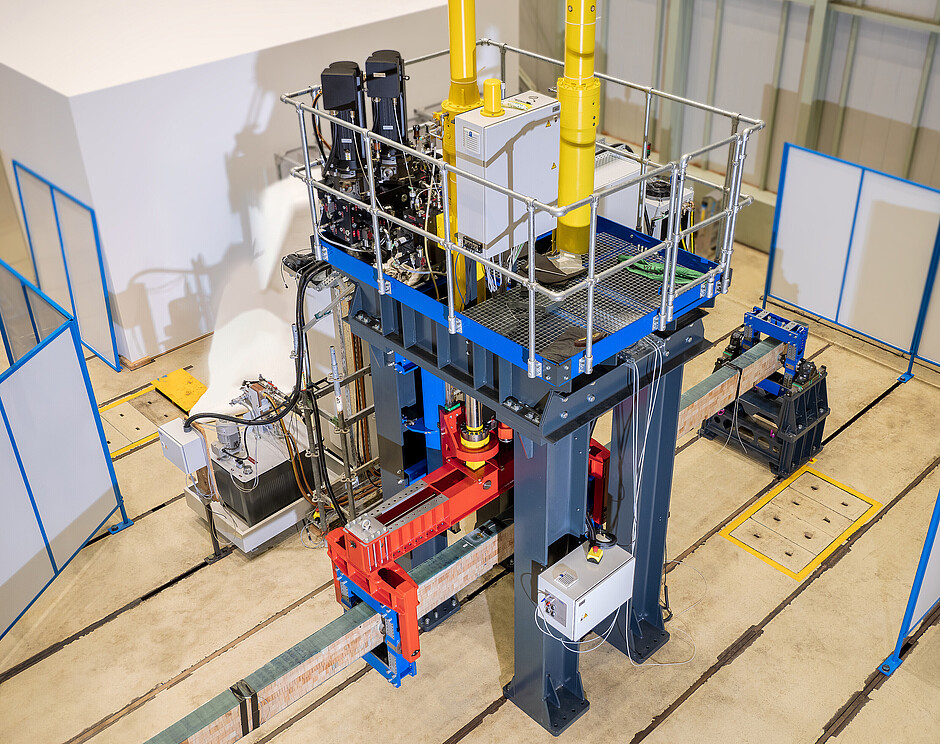
The mechanical, modular system offers the necessary flexibility to safely accommodate test specimens with different dimensions and stiffnesses.
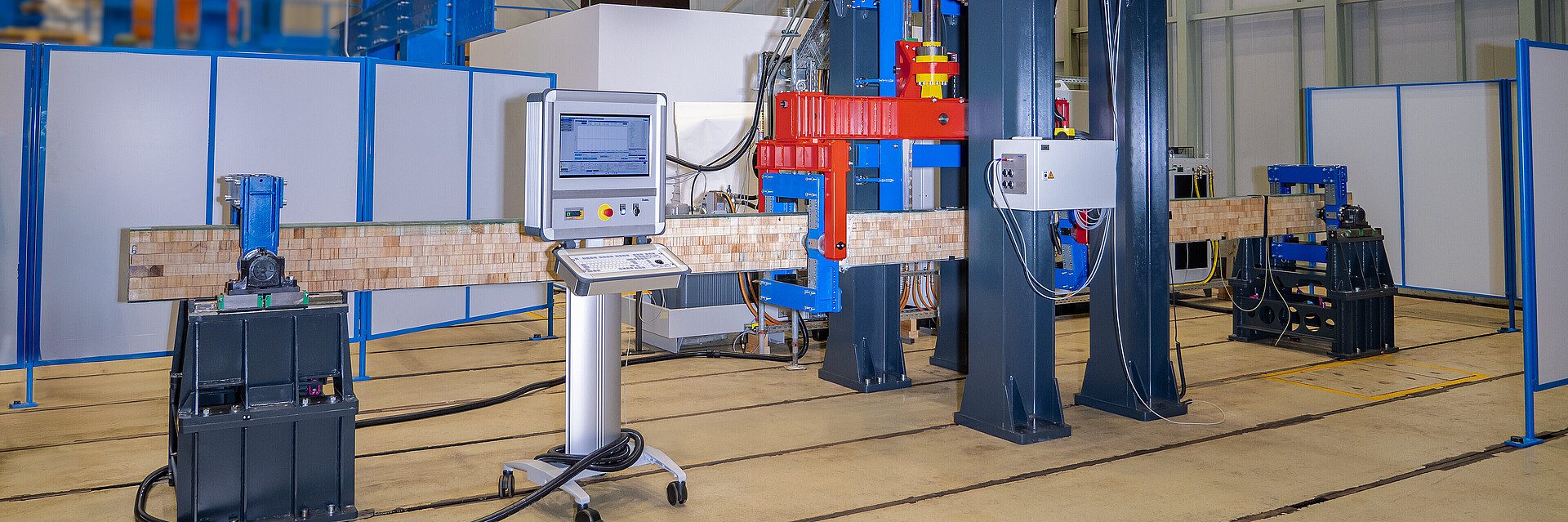
Our newly developed test bench enables cost-efficient material testing in the early stages of rotor blade development. The innovative approach: components are already tested during development. This shortens development times and significantly reduces the effort involved in the final overall validation of the rotor blade. An innovative electro-hydraulic drive concept also ensures particularly energy-efficient and resource-saving operation."
| Customer: | Nordex SE |
| Project duration: | 2 years (2023-2025) |
| Test rig type: | Large structure 4-point bending test rig |
| Test specimens: | Wooden beams made of composite material, test specimen length 2.5 to 13 m |
| Special features: |
|

✅ Turnkey solution - test bench according to specification including individual change requests
✅ Early validation - material tests without cost-intensive full-scale tests
✅ Efficient development - thanks to improved simulation models
✅ High cost-effectiveness - energy-efficient and low-maintenance test benches
✅ Compact design - space-saving thanks to modular structure
✅ Easy integration - quick commissioning, also as a stand-alone solution

The energy-efficient, electro-hydraulic drive concept uses frequency-controlled servo pumps instead of lossy valve technology. As a result, the oil flow is controlled precisely and in line with demand.
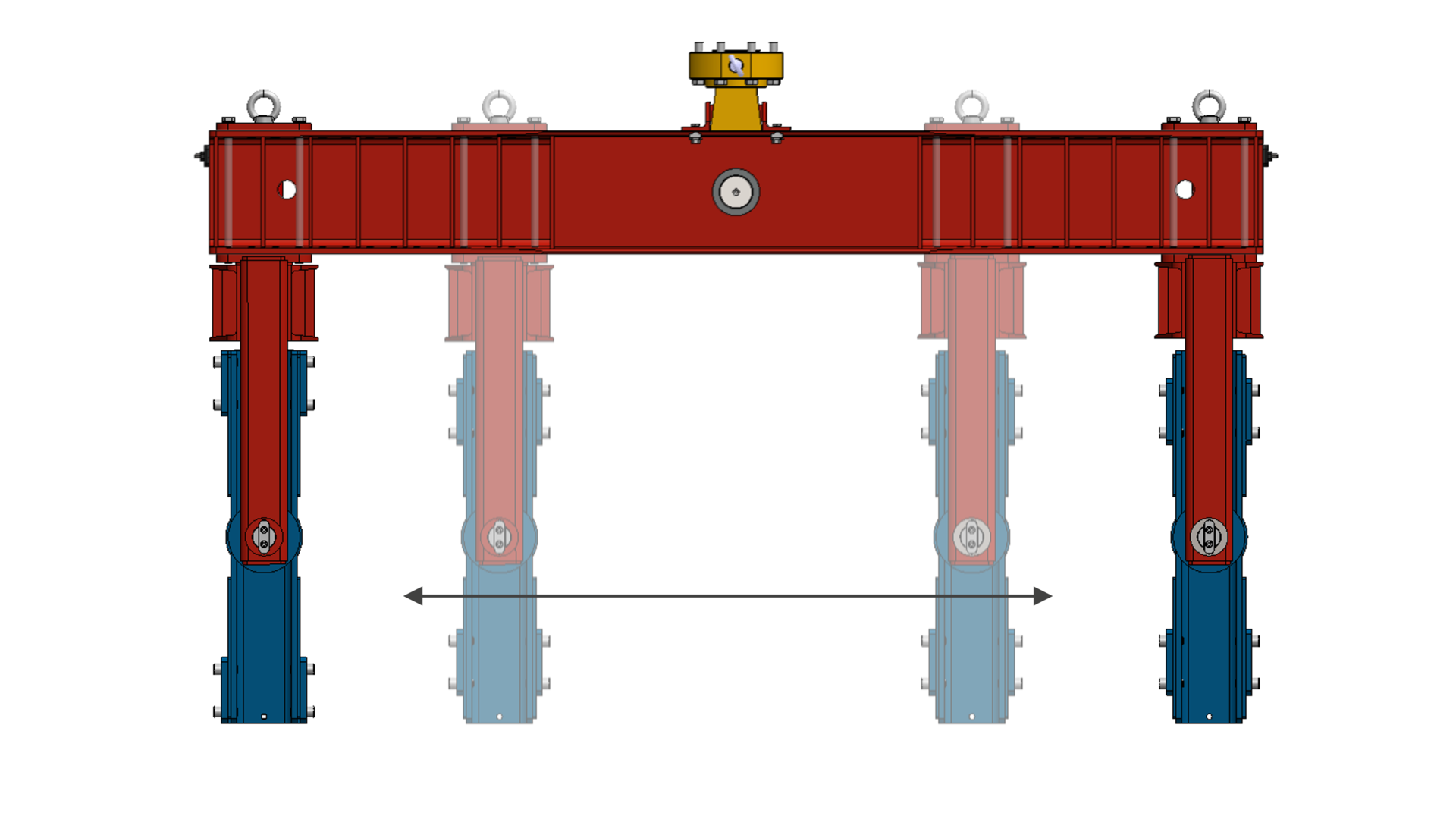
The mechanical, modular system offers the necessary flexibility to safely accommodate test specimens with different dimensions and stiffnesses.
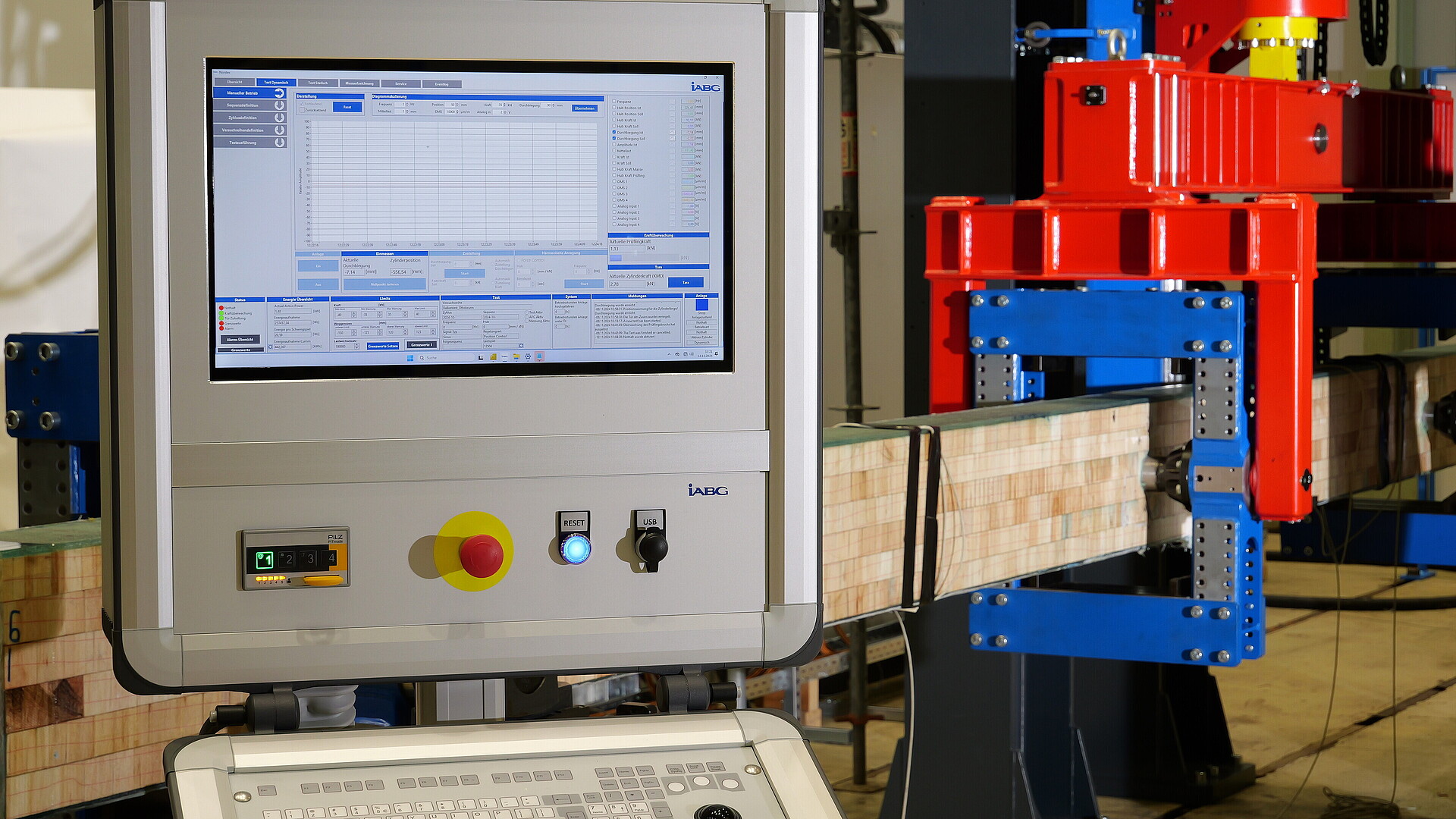
The system control is based on a powerful Beckhoff PLC with integrated safety control and is supplemented by a high-resolution, modular measuring system.
By specifically testing CFRP/CFRP test beams under realistic loads, material properties can be evaluated in a well-founded manner in early development phases and potential weak points can be identified at an early stage. The knowledge gained in the process flows directly into the further development of simulation models and design concepts. As a result, the validation effort is reduced considerably: significantly fewer full-scale tests need to be carried out and correspondingly fewer complete rotor blades need to be manufactured for testing.
The mechanical design of the test stand allows it to be adapted to a wide range of test specimen geometries thanks to two different and modular clamping concepts. Thanks to the variable drive technology, the system can be used for both static individual tests and dynamic continuous loads. This gives the test stand maximum flexibility for future test requirements.
The electro-hydraulic drive system works up to 4.4 times more efficiently than conventional servo-hydraulic solutions. By using frequency-controlled servo pumps and recuperation of deformation energy, energy consumption per load cycle can be reduced by up to 77 percent. For typical endurance tests with over one million cycles, this corresponds to savings of several thousand euros per test campaign. Over the course of a year, this results in a potential economic benefit of up to 270,000 euros.
Tip: With our interactive energy savings calculator you can easily simulate and determine your individual savings potential.
With our interactive energy savings calculator you can easily simulate and determine your individual savings potential.
Material and manufacturing-related variations can affect the strength and load-bearing capacity of fibre-reinforced polymer composites. Using material analyses and finite element simulations, we investigate these effects even before component testing begins. This enables critical areas to be identified, measurement points to be selected systematically and tests to be prepared efficiently.
Additional simulations also make it possible to investigate a wider range of material parameters than would be economically feasible through physical testing alone. This provides a more robust basis for assessing and optimising composite structures.
Bereits die Ausgangsmaterialien unterliegen streuenden Eigenschaften, die im Rahmen von Voruntersuchungen auf Materialebene ermittelt werden können. Neben unterschiedlichen Analysen können beispielsweise aus Schliffbildern Informationen zu Faserwinkeln und Poren, sowie aus Zugversuchen die Eigenschaften des verwendeten Harzsystems ermittelt werden.
FE simulations can be used at an early stage to investigate how variations in input parameters – such as material properties, fibre angles and ply thicknesses – affect the load-bearing capacity of a structure. This allows critical areas to be reliably identified and measures to optimise the structure to be derived. The results can also be used to select measurement points systematically.
Depending on the structure and size of the test specimens, the number of physical tests that can be performed is often limited. Complementary simulations covering a wider range of variations in material parameters and properties can be conducted alongside physical testing, providing a broader basis for assessing the test results.
Targeted analyses can be performed to assess the robustness of components against material- and manufacturing-related variations.
We look forward to hearing from you!

Please fill in the form and we will get in touch with you as soon as possible.
This section contains third-party content that you can view with a single click.
By loading the form, personal data may be transmitted to the third-party provider. You can find more information in our privacy policy